I slide the sheet of raw cookies into the oven. Douglas fir trees sit still, leaning into the canyon, wafting scents of maturity.
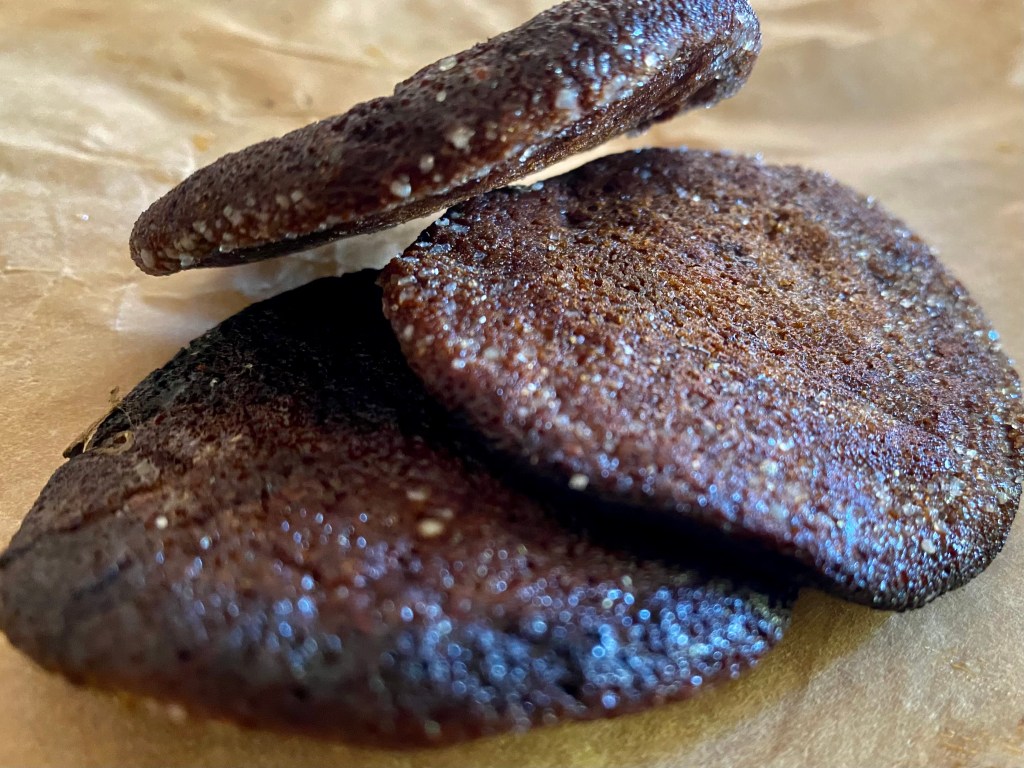
I missed the timer. The cookies burned; black and hard in a matter of minutes.
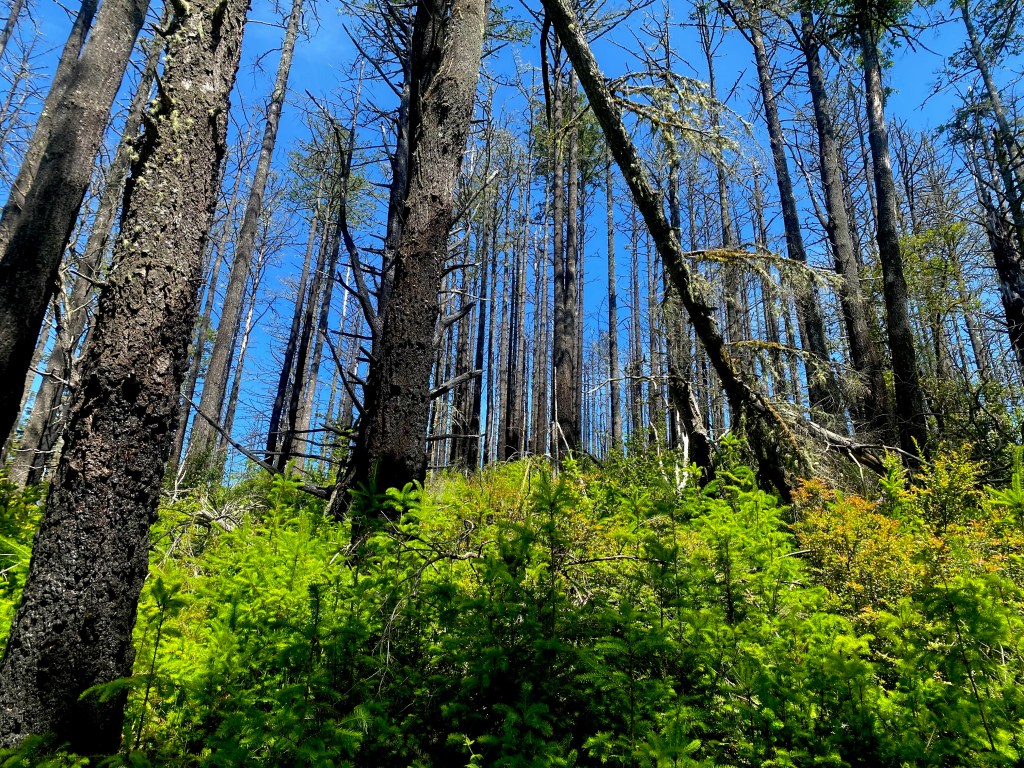
that same fir forest caught too much heat. A single spark, in a few centuries of growth, and everything was burnt and hard. And standing, to be remembered.
Still in loss, we reach began again.
This time my eyes stayed home. This time with the deep breath that comes after ruin.
The fir cones cuddled befriended by the fire cleared mineral rich ground.
When the rains returned, thousands of seedlings rose as small green monuments in the headlands of recovery.
That is how attention works. How resolve roots itself. In their world. In mine. In ours.
The birds—thousands upon thousands—pass in darkness heading north while the weary take refuge for a spell in the welcoming and generous Laguna.
Even as the land dries, a narrow waterway ties the Laguna to its watersheds and, eventually, to the Russian River. Other waters linger too, but in secretive pockets—vernal pools, elusive while out in the open fields.
Today’s walk is for them.
A Familiar Path
We slip past the back edge of a modest trailer park to a worn path, familiar. I keep my trained eyes in motion, scanning for hazards—gopher holes, soft ruts—those quiet hazards of flatland walking. My peripheral vision still serves me well.
To the east, my eyes settle and find rest in the mountains. Mount St. Helena sits in relief, her western face abrupt and stern. On cold mornings, from the next ridge, steam from the geysers can be seen following the wind steadily skyward.
Once, people went there to heal in hot mineral baths. Now the steam turns turbines for the grid, closed to seekers.
Vernal Pools and Old Land
Below those mountains, the Russian River Valley holds simpler patterns. The tall grasses, even after a generous winter, have dried into a palette of muted straw. Valley oaks cast long, knowing shadows. This is old land.
My guide, my wife, calls out a vernal pool. Modest from this distance—barely a shimmer of green, dusted over with minute blossoms. Easy to overlook. Easy, in the past, to lose to development.
I walk gently, heel first, careful not to disturb what might lie beneath: Pacific chorus frogs, maybe a salamander or two. The ground is too wet for sitting, so I use binoculars from the edge, taking in the full reach of it—perhaps two feet deep, and no wider than a living room.
But inside, there’s movement. Fairy shrimp, suspended and ancient, the size of a comma, in clear water.
How is it these pools, so fleeting, carry such weight? What matters here exists beyond our frameworks—beyond human use or recognition.
The Return View of Wonder
I turn back the way I came. I’ve never minded an out-and-back trail. The return reveals the reverse view of wonder. From the oaks, Song sparrows, Bullock’s orioles, King bird—all engaged in their seasonal rites.
Overhead, the larger birds circle high, waiting for quiet. Waiting, perhaps, for our departure from their brief and bountiful café.
No need to pity the frogs. They’ve adapted to the temporary and the invisible. They know when to sing, and when to go still.
Learning to Tend the Garden—and Myself—By Feel, Not Sight
In the slow shift from winter to spring, I’ve found a new rhythm in the garden—less about conquering, more about listening. With my eyesight changed and my tools narrowed, I’ve begun to notice what I once worked too quickly to see.
In spring, after the long, heavy weight of winter has finally lifted, the ground lets go. Moisture still clings to the roots, and weeding becomes something like house painting—ritualistic, restorative. I’ve come to love it.
I remember painting my new grandson’s room not long ago. Broad, sweeping gestures with the roller, a fine mist of paint rising and drifting like pollen on the air. That roller, the only tool I could manage now. I can’t do the fine work anymore—the cutting-in around the windows, the careful edging along the trim. Once, when I could see, I was the fastest and the best. That’s not just memory speaking; it’s fact. I had the eye, the steady hand.
Now I find the same quiet satisfaction in filling a landscape bin to the brim with the invaders: wild geraniums, the sticky ones that sneak in under cover, mostly hiding among the innocent. I’m given a short list—two or three kinds I’m allowed to pull. It’s a careful operation, something almost meditative. Like a monk tending the sand garden, I tread softly, kneel with head low, mindful of the resident pollinators—those delicate first-year perennials just beginning to claim their place, or the tough little elders, half-buried under brash newcomers.
Franny walks me through, as she does from time to time, pointing out the offenders with little risk of harming her resident pollinators. I listen. These weeds are generous this time of year—they surrender easily. And clearing them away brings back order: the eye can follow the natural lines again, the bees can trace their scented paths, and our black and white cat can stalk through the newly opened trails with the self-importance only cats can manage.
There was a time when I tackled the garden with power tools. Big jobs. Loud jobs. I didn’t weed much then—it seemed too small, too tedious. Now it feels like purpose. I like being of use. I’m learning the slow art of tending, and in doing so, I’m rediscovering the quiet authority of the garden—its power, its patience, and the way it makes room for everything, even me.
Being in the blind community, I’m often told to continue doing what I love to do. Just do it differently. Hearing that mantra hitches on to the ‘old school’ mottos of ‘get yourself up, dust yourself off, and start all over again’. Those youthful jingles sometimes push us, sometimes encourage and sometimes bite.
With years of High Sierra hiking under my belt I went to Nature to understand how to carry on with my passions in the face of dramatic changes to my abilities. I now hear, ‘look at the creek racing down the mountain. Last year in a massive storm with high winds, a blow down’ of a tree community clogged the creek’s path with debris of loose rock, dirt and branches. What did the creek do? No pondering or hand ringing. The creek kept moving, right? Or, in this case, the creek made a pond and then flowed over the top of the debris.
One of my struggles in adapting my baking style is the rhythm of my moves about the kitchen. Flowing from recipe to gathering and measuring ingredients to mixing and baking. with much experience a cadence develops and is memorized by my soul. In my blood in other words. With low vision the rhythm has slowed and the cadence revised through new steps taken to ensure I’ve not missed an important point in a recipe or that I’ve measured correctly, gathered all the ingredients, mixed just right and baked to perfection.
In conversation, the creek changed its rhythm, adding steps: a pond, overflow over a dam. As an ancient example I tingle realizing the connections as I stand in a fast current in a wild river casting a fly to a spot behind a large boulder. Because I walk the river understanding better its features. Its riffles, eddies, pools and all the rest. The understanding that change is forever and my changes in vision and body function are simple and natural and I must simply let loose and be in my flow. as it changes throughout the length of a river, of a life.


 Adapting Daily